Upmix
An upmixer takes an input signal and maps it to more speakers than it was originally mixed for — for example, spreading a stereo or 5.1 soundtrack across a full height and wide speaker layout. The Upmix page lists every available upmixer, lets you turn each one on, choose whether it appears as a button on the Home page, and adjust the settings specific to it.
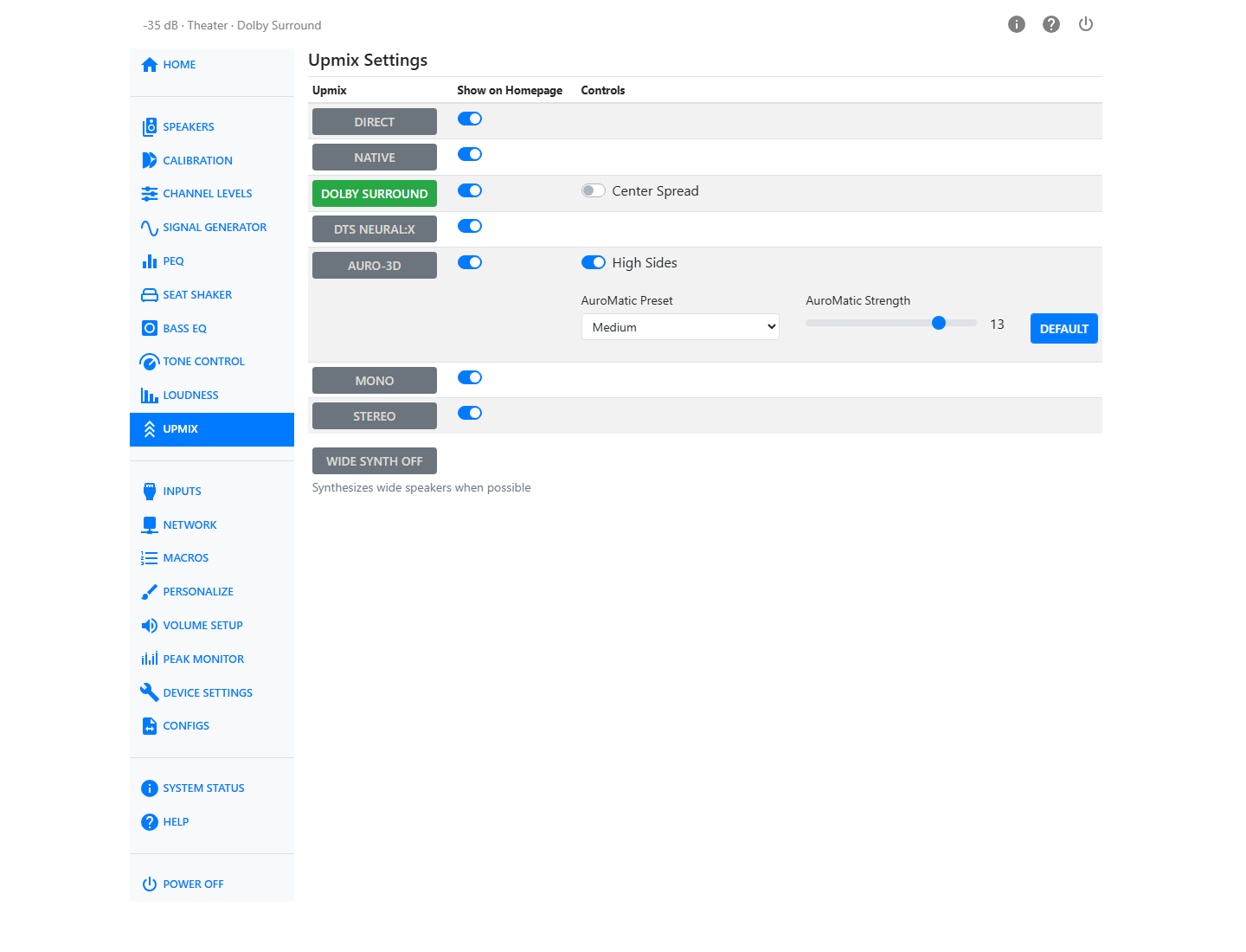
You request an upmixer through the interface, but the requested mode may not always be possible. The current mode is shown in the audio status. This is most often noticed when you request something like Auro-3D but the source is Dolby Atmos or DTS-X — only the mono and stereo modes can override a native Atmos or DTS-X stream.
Available Upmixers
| Upmixer | Description |
|---|---|
| Direct | No upmixing algorithm is applied — decoded audio is played directly, with the upmixer off. All other processing (channel levels, bass management, tone control, loudness, PEQ) still applies. Program material is presented at its original sample rate. Whether the subwoofer is engaged depends on the bass management settings on the Speakers page. |
| Native | HTP-1 uses whichever upmixer is native to the decode format. Dolby signals are processed with Dolby Surround, DTS signals with DTS Neural:X, and Auro-3D encoded signals are decoded. PCM sources receive no upmixing, and Auro-Matic cannot be applied to 192 kHz content. |
| Dolby Surround | Dolby's own upmixing algorithm, an evolution of the older Pro Logic algorithms. It uses cues in the signal to route sound to the speaker set, including extracting material common to left and right into the center channel. It works with any combination of available speakers, though some channels may stay silent depending on the source — a mono input produces sound only from the center channel. It does not generate wide channels. |
| DTS Neural:X | DTS's own upmixing algorithm, an evolution of the older Neo algorithms, following the same kind of rules as Dolby Surround. Neural:X natively outputs up to 12 channels (7.1.4). |
| Auro-3D | Auro Technologies' Auro-Matic algorithm, again extracting common left/right material to the center channel. When upper speakers are present the effect is called Auro 3D; without upper speakers it becomes Auro 2D. Auro-Matic is not applied to 192 kHz content. |
| Mono | Mixes the input down to mono and applies the same mix to every speaker. |
| Stereo | Mixes the input down to stereo and applies the left and right channels to all left and right speakers respectively, with a mono mix routed to the center. |
Note
Dolby Atmos and DTS-X streams play in their native format and cannot be requested or replaced by another upmixer, except by Mono or Stereo.
Sample Rates and Direct Mode
Direct is the only mode that presents program material at its original sample rate, which makes it the mode to use for high sample rate content at 96 kHz or 192 kHz. Every other upmixer runs the signal through a high quality sample rate converter that reduces the output to 48 kHz (or 44.1 kHz).
Dirac Live filters also limit the sample rate to 48 kHz. If you want to take advantage of high sample rates, disable Dirac Live filtering as well as choosing Direct.
Show on Homepage
Each upmixer has its own Show on Homepage switch. Turn this on for the upmixers you switch between often, so they appear as buttons on the Home page.
Dolby Surround: Center Spread
When Dolby Surround is selected, a Center Spread switch becomes available. Turning it on spreads the center channel signal to the left and right front speakers as well, in addition to the center.
Auro-3D Controls
Selecting Auro-3D reveals three additional controls:
- High Sides — when off, high side content is mixed to the rear height or top rear speakers. When on (the default), it is mixed to the top middle speakers instead.
- AuroMatic Preset — one of Small, Medium, Large, Movie, or Speech. This shapes how much the Auro-Matic upmix behaves like an added-reverb effect.
- AuroMatic Strength — a slider from 1 to 16 controlling how much of the Auro-Matic signal is mixed into the original. A Default button restores the factory value.
Wide Synth
Most source material does not include dedicated wide-channel content, even though Dolby Atmos can carry objects placed there. Dolby Surround does not produce wide channels, and Neural:X outputs 12 channels (7.1.4), so DTS:X configurations can provide upper front and rear channels but no top middle channels.
Wide Synth generates signals for the wide channels and/or the top middle channels when speakers are present but the decoded audio contains no signal for those channels.
The synthesized signals are derived using principles based on Michael Gerzon's research. Wide Synth creates new channel content from adjacent channels — for example, the left wide channel is synthesized from the left and left surround channels.