Integrations and Control
Using Roon
The HTP-1 is a Roon Ready device — Roon can send audio to it directly, with no separate app or streamer needed. Roon is a music service you subscribe to, built around a locally stored or network-attached music archive that can include high-quality formats like 96 kHz/24-bit and 192 kHz.
A Roon system needs a Roon Server, which knows where your music is (this can run on a PC or a NAS), and a controller to browse your library and press play — the Roon app on a phone or PC. The HTP-1 does not perform either of these roles; it is only the output device.
Select the Roon input on the HTP-1, then pick the HTP-1 as the output zone in Roon. It appears in Roon's device list under whatever you've set as your Unit Name on the Device Settings page.
The Roon input works like any other input on the HTP-1: you can apply any of the upmixers to expand a stereo Roon stream across your speaker layout, or leave it at Direct to pass the source sample rate through unchanged. Every other upmixer resamples to 48 kHz (or 44.1 kHz), and any loaded Dirac Live filter also caps output at 48 kHz — so a stream above that rate only stays at its original rate with Direct selected and Dirac Live off.
Note
Streaming at 44.1 kHz can be less stable through the Dirac Live path than 48 kHz. If you see issues, set Roon to resample to 48 kHz for this zone.
See System Status for the current release notes, which cover the latest Roon behavior and any open issues.
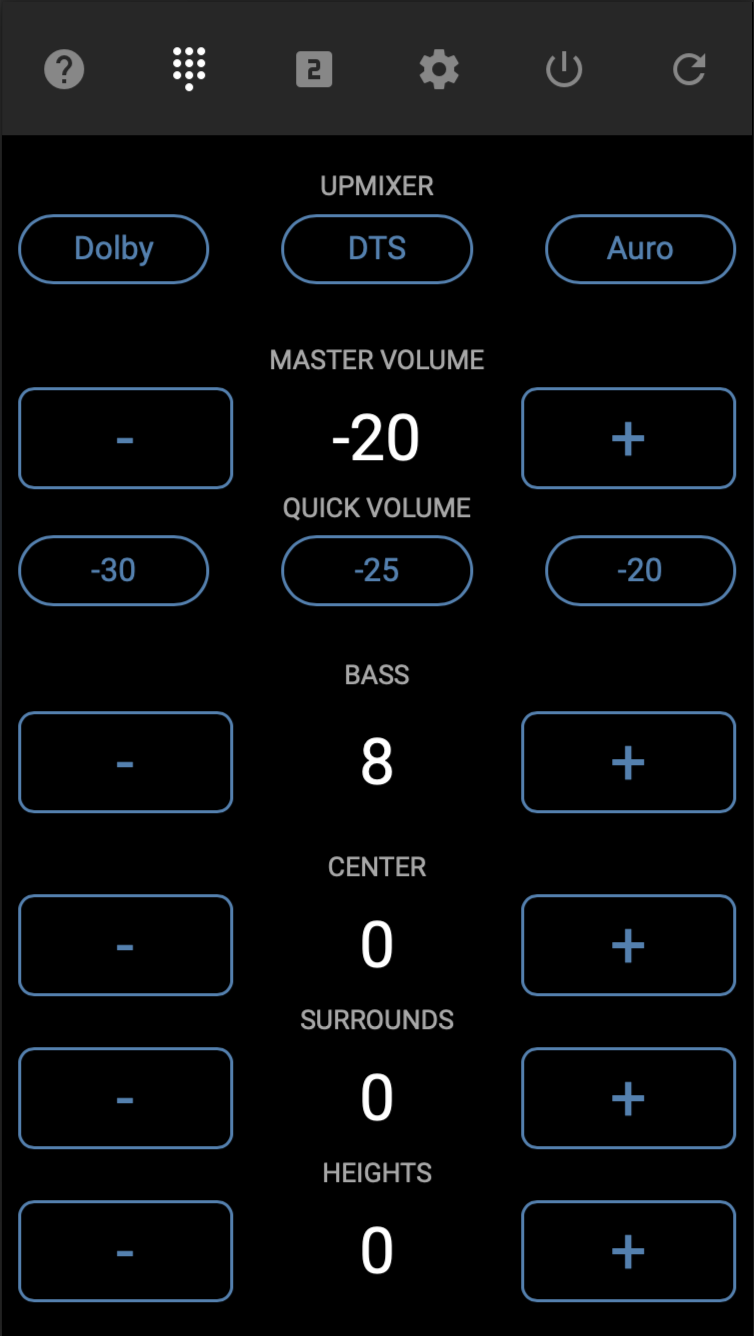
Mobile Remote
The HTP-1 serves a simple remote control page for phones and tablets at
http://<your-htp1-ip>/remote/. It gives you a lightweight way to control volume, bass, upmixer, center/surrounds/heights level, and
power without loading the full web UI.
HTTP Control
The HTP-1 accepts IR commands over plain HTTP, which makes it straightforward to drive from home automation systems such as Control4, Home Assistant, or Crestron, or from your own scripts. Send a request to:
http://<your-htp1-ip>/ircmd?code=XXXX
where XXXX is one of the codes from the IR code tables in Reference.
More than one code can be sent at once, separated by commas.
-
Turn on Dirac Live filter slot 1 and unmute:
curl "http://<your-htp1-ip>/ircmd?code=7887,4cb3" -
Select HDMI 1 and set the upmixer to Native:
curl "http://<your-htp1-ip>/ircmd?code=0ff0,1ee1"
Every request returns the full system status as JSON, so a script can also use /ircmd to read
current state after making a change.
Third-Party Applications
A number of third parties have built their own tools around the HTP-1, which are listed in the separate Apps & Integrations section.
They are discussed in the Official Monoprice Monolith HTP-1 Owners Thread on the AVS Forum.
If you're building your own integration, see the Developers section of this site for the underlying control protocol.