Updates and Support
Checking Your Version
Open System Status to see the software version currently running, under System Software Version. If a newer release is available, an Update available badge appears next to the Open History page button.
Reading Release Notes
Click Release Notes, next to the software version, to see what changed in the current release — new features, fixes, and any known issues. Read these before updating, especially if you rely on a feature that could be affected.
Performing an Update
Click Open History page on the System Status page. This opens a separate page listing available software releases.
Releases on the master branch are recommended for most users. Preview, Beta und Release Candidate releases are also listed; these are newer builds still being tested, and are meant for owners who want to help find problems before a release reaches master. Choose a release from the list to install it. You will be asked to confirm before the update starts.
Tip
Export a configuration backup before updating, in case anything needs to be restored afterward. See Backup and Restore.
What to Expect
Once an update starts, the web UI switches to a full-screen progress view with a status message and a progress bar. This can take several minutes depending on what changed in the release. Don't close the browser tab or power down the unit while this is showing — the unit reboots on its own when the update finishes.
User settings, input names, and calibrations are preserved across a normal update.
Upgrading from Version 1.x
Moving from the version 1.x software to the version 2 software is a one-time procedure with a few extra steps. The update backs up your existing system so you can roll back, but take your own backup first if you have spent time configuring the unit.
Export your settings from the Backup and Restore page before you begin. You can also export your existing Dirac Live filters from that page as an extra copy. Those exports are in the older filter format and cannot be loaded into the new system, but they are worth keeping.
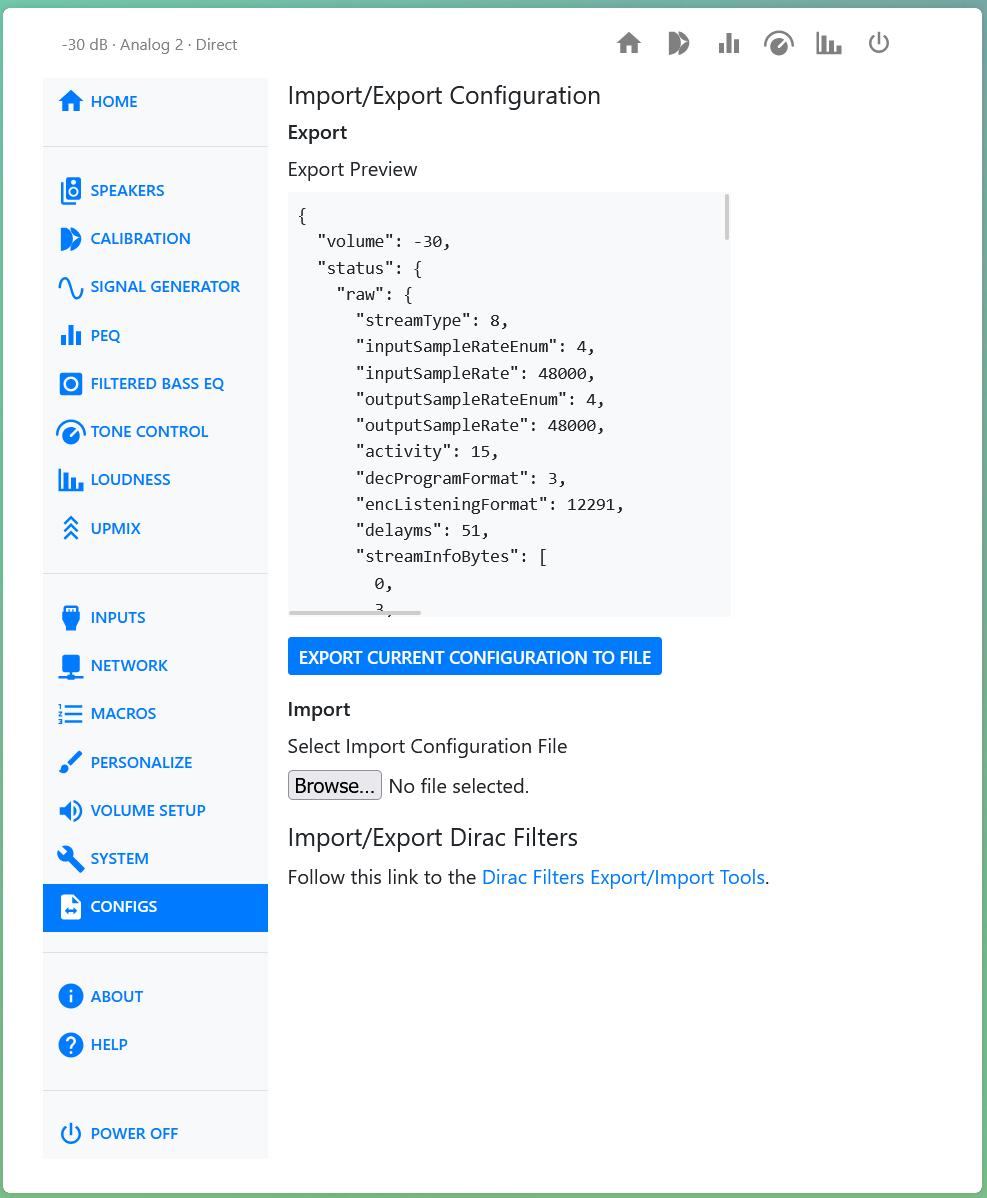
Then perform the update in two stages:
- Open History and Updates from the System Status page. It can take a few moments for the list to appear. If it times out the first time, try again.
- Install the release labeled final non-ART build first. This creates the backup files that let you revert later.
- When that finishes, a new release supporting Dirac Live ART becomes available. Install it.
Your existing Dirac Live filters are preserved, and you can revert to the earlier software if you need to.
Your First Calibration Afterward
No Dirac Live filters are loaded when the new software starts for the first time. To be sure the unit begins in a consistent state, change the speaker layout twice before calibrating: select a layout you do not intend to use, then switch to the layout you want to calibrate. Preparing an unused layout takes about 30 seconds. This is only needed once.
Tip
Each time you change the speaker layout, the filter cache is cleared and reloaded for the new layout. With large speaker configurations this takes a while — loading six filters for a 7.3.6 layout can take up to 10 minutes. If you want to compare layouts, keep one or two calibrations per layout to reduce the wait.
Support
Downloading Logs
Open Device Settings, then the Danger Zone section, and click Download Logs. This
downloads quicklogs.zip, a set of logs useful for troubleshooting. It does not contain any
personally identifiable information.
Send this file along when you report a problem — it gives the development team the detail needed to reproduce and diagnose it.
Submitting Feedback
When the HTP-1 is in standby, the web UI shows a Quick Links list with a Submit Feedback
link. This opens a form hosted on the unit at http://<your-htp1-ip>/feedback.
Note
This form is not a customer support request — think of it as a suggestion box. It's optional and anonymous unless you choose to leave a contact address. If you need help with a problem, include your contact details or reach out to support directly as well.
On-Device Help
Every page has a Help entry in the sidebar, and a "?" icon that jumps straight to the section for the page you're on.